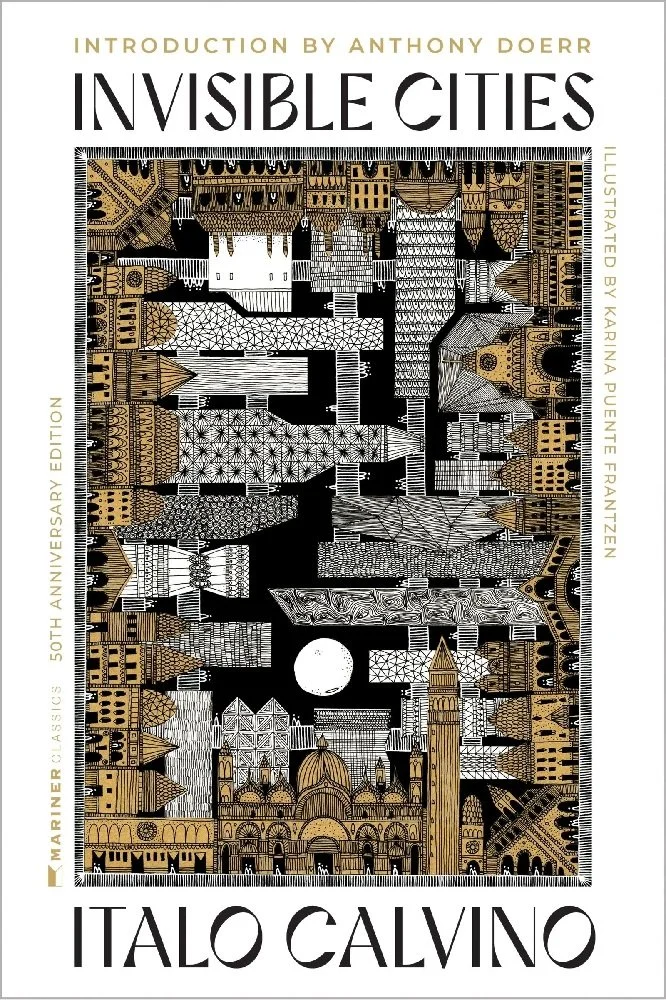
Invisible Cities - Italo Calvino
At face value, Invisible Cities comes across as a travelogue, a series of short descriptions of cities spread across the world being described by Marco Polo to a weary and exhausted Kublai Khan at the height of his empire's expansion, weighed down by the growing and insidious rot that inevitably plagues all world powers; complacency, corruption, and eventual insurgency.
It becomes apparent that Calvino’s Polo is recounting his travels not from the anchors of known history or geography but from the fantastical, incongruous, philosophical hearts of mankind. These cities aren't so much as invisible as they are impossible. Polo describes utopias and hells, kingdoms in the sky and mirrored worlds in the bedrock. His cities aren't only mystical, but from times ancient, contemporary to our companions, set in the reader's present, and unknowable futures.
What Polo is sharing with Khan is not geography or history, it is a sacred wisdom of what catalyzes humanity’s everchanging soul. Within each passage are parables on the triumphs and foils of civilization, and each group of passages is wrapped within an insightful meta-narrative between Polo and Khan, reflecting on what these stories may mean for a homesick Polo and a warlord who is losing control of his life's work.
For the reader, Invisible Cities is like taking a road trip at night with the windows down through a fever dream. Each city has new air to breathe, new vistas to absorb, new ideas to consider. For fans of Calvino, he is an author known for word play, writing within mathematical structures (he was a part of the Oulipo writing troupe who enjoyed such constraint) that could demand a lifetime of study. In the end, Invisible Cities is a concise and sharp treatment on life and society made endlessly consumable, and most importantly enjoyably memorable, through Calvino's thoughtful framing and beautiful prose. It is a timeless classic.
5 out of 5