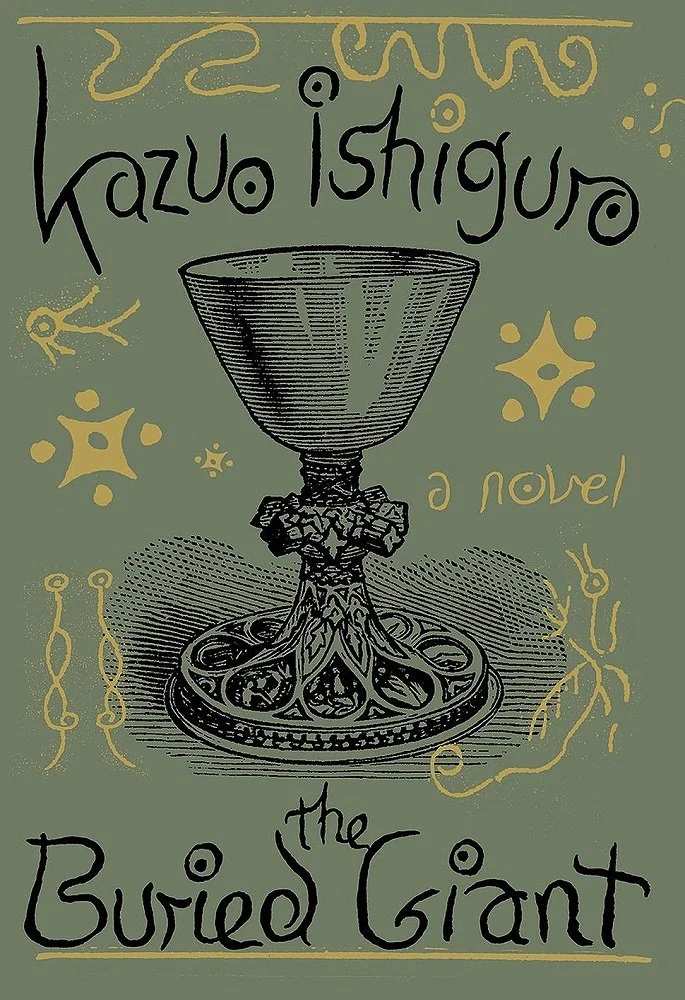
The Buried Giant - Kazuo Ishiguro
So it appears that The Buried Giant may be one of Kazuo Ishiguro’s most polarizing works, for as I finished the novel I went searching for discussion about it as it resonated so strongly with me, both as a perhaps arms-length fantasy novel, but also as a profoundly intimate look at how relationships cope with the inevitability of age. But where I found honest and flawed beauty, others found a feeble fantasy, and so I'll plead my case.
On its surface, we follow an elderly couple in post-Arthurian England who live in a realm plagued by an insidious mist, one that consumes people’s memories. What is left of life in its midst are husks of people hobbled together in dotted villages set to piece together what meaning they can to survive but little more. On a whim, with only whispers of returning lucidity, the man and woman decide to embark on a trip to find their grown son who had left them many years ago. Along this journey they come across ogres, knights, warriors, and outcasts. The rest of the core story I will leave unspoiled until later, you have been warned.
Ishiguro’s writing is haunting, weaving a fantasy story that is somewhat detached from much of the genre’s typical dense world building and pared down to the essentials that leaves the experience quite open to the imagination. This isn’t new for Ishiguro, it's a staple of his writing, effective for his sci-fi with Klara and the Sun just as it is here for fantasy. For fans of “I Who Have Never Known Men,” this minimalism will feel expansive and freeing. For those more familiar with established canon of the genre, you may feel the set pieces are scant and unfulfilling. I am in the former group. I felt reverence, not self-indulgence for the setting and tropes come through in his writing, but others may feel he was too timid to fully engage with it.
THEMATIC AND STORY SPOILERS AHEAD: Either way, Ishiguro is as effective as ever addressing his central themes of memory, loss, and identity. Later in the story, as individuals’ motives and backstory are laid bare, we find our protagonist couple regaining their memory. Many of those memories validated the love that these two felt for one another. Some spoke of the friction of a long and imperfect marriage. More still hinted at a near infinite heartache. Regardless, all at once I was hit with the parallels of the ending to dementia, how a loving couple can spend a lifetime of love, the highs and lows of decades of togetherness and constant finding of one another, for it to only vanish into the clouds of obscurity and confusion as disease sets in. What matters then isn’t the house on the top of a mountain of time you’ve built together over eons, but the unwavering support you provide each other moment to moment for no reason other than you love that other person. The brief flash of presence they had together at the end, as they said their knowing farewell to one another, was breathtaking. One made to return to shore, to live his days alone. The other to move on with the boatman to an uncertain future, to hold on to the hope of one day being reunited again in happier times, in healthier bodies. The quiet pain of that goodbye, his writing of that bittersweet sudden clarity that many afflicted do experience, will be in my thoughts for years to come.
Throughout is stark imagery that poses difficult questions of society at large; how does individual agency weigh against the evils of generational hatred? What cost is peace worth? How precarious is a truce when it relies on illusionary tricks, no matter how benevolent. But all of this, for me, pales in comparison to the smaller, yet more profound, quest of two people, bound by their unyielding love for one another despite it all.
Now I don’t know if this was the author’s intention. But isn’t that the beauty of reading and art, that each of us can come away with something that resonates in the lives we each have made? The Buried Giant reframed my thinking of time, or more accurately, time spent together. Decisions made in a family carry weight beyond what can be imagined and when the time comes, the sadness of well-earned heartache, made over a lifetime of selflessness, is a lesser burden to carry than that of regret.
4.25 out of 5